
🤯 Forget Link Building: Here’s How to Dominate SERPs From the Inside Out
The relentless pursuit of backlinks can feel like a digital hamster wheel. You spend countless hours and a significant budget on outreach, guest posting, and digital PR, often for just a handful of mediocre links. What if you could sidestep this entire process? The concept of ranking without backlinks isn’t a fantasy; it’s a strategic pivot towards what you can control: your own website. In 2025, Google’s algorithms are smarter, more intuitive, and place an immense value on genuine user satisfaction. They are increasingly capable of understanding quality and authority directly from your site’s content and structure, without needing as many external “votes” of confidence.
This isn’t about finding a loophole. It’s about building a website so fundamentally sound, so technically perfect, and so rich with valuable content that Google has no choice but to recognize its authority. It’s about shifting your focus from begging for external validation to earning your rank from the inside out. This comprehensive blueprint will guide you through the exact, actionable strategies required to achieve significant search engine visibility.
We will dissect the pillars of on-page SEO, technical mastery, and user experience that form the foundation of a successful backlink-free ranking strategy. Prepare to transform your website into a self-sufficient ranking powerhouse.

🎯 Is Ranking Without Backlinks a Myth or a Tangible Reality?
Let’s address the elephant in the room immediately. For years, the SEO mantra has been “backlinks are king.” So, is the idea of ranking without backlinks just wishful thinking for overworked marketers and solopreneurs? The answer is a resounding no, but it comes with important caveats. It is absolutely a tangible reality, especially for websites targeting low-to-medium competition keywords. The landscape of search has evolved dramatically. Google’s primary objective is to satisfy the user’s query with the most helpful, relevant, and trustworthy result. While backlinks have historically been a primary proxy for trust, Google’s algorithms have become far more sophisticated.
Think of it like this: backlinks are letters of recommendation for a job. They are powerful, and a glowing reference from a respected figure (an authoritative site) can certainly help you land an interview. However, if your resume (your website’s content and technical structure) is impeccable, detailed, and perfectly matches the job description (the search query), you can absolutely get the job on your own merits. Google’s Helpful Content Update and its emphasis on Experience, Expertise, Authoritativeness, and Trustworthiness (E-E-A-T) are direct signals that on-site quality is paramount.
Google is now better at evaluating the “resume” directly, rather than just relying on who recommended you.
This strategy shines in specific scenarios. New websites can use it to build a strong foundation before ever starting outreach. Niche sites can dominate their specific vertical by becoming the ultimate topical authority. Local businesses can leverage local signals to rank for geographic queries without a single guest post.
The goal isn’t to declare backlinks obsolete; they will always be a powerful signal. The goal is to build a website so strong that it doesn’t need to depend on them, allowing you to rank for meaningful keywords while you “optionally” and strategically acquire links later, pouring fuel on an already roaring fire 🔥
🏛️ The Bedrock of Success: Mastering Foundational & Technical SEO
Before you write a single word of content, you must ensure your website is a place Google’s crawlers love to visit. Technical SEO is the bedrock upon which your entire strategy for ranking without backlinks is built. If your site is slow, insecure, or confusing for search engine bots to navigate, even the world’s best content will be buried in the digital abyss. Think of it as building a magnificent skyscraper. You wouldn’t start with the penthouse suite; you’d start by digging deep and pouring a massive, reinforced concrete foundation. Technical SEO is that foundation.
It’s the unglamorous but absolutely critical work that makes everything else possible.
⚡️ The Need for Speed: Core Web Vitals and Page Experience
In 2025, speed isn’t just a feature; it’s a prerequisite for user satisfaction and a direct ranking signal. Google’s Core Web Vitals (CWV) are a set of specific metrics that measure the real-world user experience of a page: loading performance (Largest Contentful Paint – LCP), interactivity (First Input Delay – FID, soon to be replaced by Interaction to Next Paint – INP), and visual stability (Cumulative Layout Shift – CLS). A poor score here tells Google that users will get frustrated on your site. You can use Google’s PageSpeed Insights tool to diagnose issues. Common culprits include large image files, render-blocking JavaScript, and slow server response times.
💪 Optimizing these elements is a direct investment in your ranking potential
📱 Mobile-First Indexing: Your Non-Negotiable Mandate
The majority of Google searches now happen on mobile devices. Because of this, Google predominantly uses the mobile version of your content for indexing and ranking. This is not a suggestion; it’s a mandate. Your site must be perfectly responsive, meaning it looks and functions flawlessly on a smartphone, tablet, and desktop. Text must be readable without zooming, clickable elements must be spaced appropriately, and content should not be wider than the screen. Use Google’s Mobile-Friendly Test to ensure you’re compliant. A poor mobile experience is one of the fastest ways to be dismissed by Google, regardless of your content quality.
🔐 Secure and Accessible: HTTPS and Crawlability
Security and accessibility are fundamental trust signals. Your website must use HTTPS (Hypertext Transfer Protocol Secure). An SSL certificate encrypts data between your server and the user’s browser, protecting their information. Google Chrome actively flags sites without HTTPS as “Not Secure,” which erodes user trust and negatively impacts rankings.
Beyond security, your site must be crawlable. This means ensuring your `robots.txt` file isn’t accidentally blocking important pages and that you have a clean, logical site architecture. If Googlebot can’t find or access your pages, they simply won’t be indexed or ranked.
✍️ The Content King(dom): Crafting Content That Ranks on Its Own Merit
With a solid technical foundation in place, your content becomes the star of the show. In a world without a heavy reliance on backlinks, your content cannot just be ‘good’; it must be the undisputed, definitive, and most helpful resource available for a given query. This is the core engine of ranking without backlinks. You are aiming to create what is often called a “digital asset”—a piece of content so valuable that it generates traffic and authority on its own, year after year. This requires a strategic shift away from simply chasing keywords to building genuine topical authority.
🧠 Beyond Keywords: The Power of Topical Authority and Semantic SEO
Topical authority is the concept of becoming the recognized expert on a specific subject in Google’s eyes. Instead of writing one-off articles on random keywords, you build a comprehensive hub of interconnected content around a central topic. This is done through a “topic cluster” model. You have a main “pillar page” covering a broad topic (e.g., “Beginner’s Guide to Indoor Gardening”) and then multiple “cluster pages” that dive deep into specific subtopics (e.g., “Best Low-Light Houseplants,” “How to Water Succulents,” “Choosing the Right Potting Soil”).
Each cluster page links back to the pillar page, and the pillar page links out to the clusters. This structure signals to Google that you have covered the topic from every conceivable angle, making your site a one-stop-shop. This is a powerful way to demonstrate E-E-A-T and is a cornerstone of modern SEO. For more on this, you can explore in-depth guides on building topical authority.
❓ Answering the Unasked: The Art of Comprehensive Content
Truly great content anticipates and answers the user’s next question before they even think to ask it. When a user lands on your page, your goal is to end their search journey. They shouldn’t need to hit the back button to find more information.
Use tools like Google’s “People Also Ask” section, AnswerThePublic, or forums like Reddit and Quora to find all the related questions, pain points, and nuances surrounding your topic. Weave these answers directly into your content. Use clear headings, lists, and tables to make the information easy to digest. The more completely you satisfy the initial search intent, the stronger the signal you send to Google that your page is the best result.
Here is a simple process for creating a digital asset that aims to rank on its own:
- 🎯 1. Identify a core user problem or a broad topic in your niche.
- 🔍 2. Conduct exhaustive research on every sub-topic, question, and angle related to that problem. Check top-ranking competitors, forums, and Q&A sites.
- 🏗️ 3. Create a detailed outline that logically structures the information, moving from broad concepts to specific details.
- ✍️ 4. Write content that is 10x more helpful, in-depth, and easy to understand than any existing resource. Use unique examples, data, and visuals.
- ✨ 5. Enhance the content with rich media like custom graphics, videos, and interactive tools to increase engagement and dwell time.
🔍 The Art of On-Page SEO: Optimizing Every Single Element
On-page SEO is the practice of optimizing individual web pages to rank higher and earn more relevant traffic. If technical SEO is the foundation and content is the structure, then on-page SEO is the meticulous interior design and signage that makes the building usable and appealing. Every element on the page is an opportunity to send clear signals to both users and search engines about your content’s relevance and quality.
🧠 Mastering on-page SEO is absolutely essential for ranking without backlinks because it maximizes the value of the assets you fully control.
✨ Title Tags & Meta Descriptions: Your Digital Billboard
Your title tag and meta description are your first—and sometimes only—chance to make an impression in the search results. They are your digital billboard. The title tag is a confirmed, direct ranking factor and should include your primary keyword, preferably near the beginning. It needs to be compelling and accurately reflect the page’s content.
The meta description, while not a direct ranking factor, is critically important for click-through rate (CTR). It’s your 160-character sales pitch. Use it to summarize the page’s value proposition, include your target keyword naturally, and entice the user to click your result over the others.
🏗️ Structuring for Success: The Magic of HTML Headings (H1-H6)
Proper heading structure is not just for aesthetics; it creates a logical hierarchy for your content that search engines use to understand its main topics and sub-topics. You should have one—and only one—H1 tag per page, which is typically your main title. Your main sections should be wrapped in H2 tags, and subsections within those should use H3s, and so on.
This structure makes your content more scannable for users and provides a clear outline for search engine crawlers, helping them with passage ranking and understanding the relationships between different pieces of information on the page.
🖼️ More Than Decoration: Strategic Image Optimization & Alt Text
Images break up text, increase engagement, and can even rank in Google Images, driving additional traffic. But they must be optimized. First, compress your images to ensure they don’t slow down your page load speed. Use tools like TinyPNG or Squoosh. Second, use descriptive, keyword-rich file names (e.g., `on-page-seo-checklist.jpg` instead of `IMG_1234.jpg`). Finally, and most importantly, write descriptive alt text for every image. Alt text is used by screen readers for visually impaired users and is also read by search engines to understand the image’s context. It’s a prime opportunity to include your target keyword or related semantic terms naturally.
🔗 The Power Within: Mastering Your Internal Linking Strategy
Internal links are the secret weapon of on-page SEO. They are hyperlinks that point from one page on your site to another. A smart internal linking strategy does three things: it helps users navigate your website, it establishes an information hierarchy (as seen in the topic cluster model), and it distributes authority (or “PageRank”) throughout your site. When you publish a new article, you should link to it from older, relevant, high-authority pages on your site. Likewise, within the new article, you should link out to other relevant resources on your site. This creates a strong, interconnected web of content that keeps both users and crawlers engaged and signals the relationships between your pages.
💡 Unlocking Hidden SERP Real Estate: The Power of Schema Markup
Schema markup, or structured data, is one of the most powerful yet underutilized tools in an SEO’s arsenal, especially when you’re focused on ranking without backlinks. Think of it as a secret language you can use to speak directly to search engines. It’s a vocabulary of code that you add to your website’s HTML to provide explicit context about your content. While it doesn’t directly make you rank higher in the traditional sense, its impact is profound. It allows Google to understand your content at a deeper level, which can unlock rich results—the visually enhanced, more prominent listings in the SERPs.
These rich results are a game-changer. They can include star ratings, review counts, cooking times, event dates, or FAQ dropdowns directly in the search results. This has two massive benefits. First, it makes your listing take up more digital real estate, pushing competitors down the page and making your result far more eye-catching.
Second, it dramatically increases your click-through rate (CTR). A user is much more likely to click on a result with a 5-star rating and a helpful FAQ than a plain blue link, even if the plain link is ranked one position higher. This is how you can steal traffic from higher-ranking competitors and prove to Google that your result is more appealing to users.
Implementing schema might sound intimidating, but it’s become much easier. Tools like Google’s own Structured Data Markup Helper and various WordPress plugins can generate the necessary JSON-LD code for you. The key is to identify the right schema type for your content. Some of the most impactful types include:
- ⭐ Review/AggregateRating: For products or services to show star ratings.
- ❓ FAQPage: To get interactive question dropdowns for informational content.
- 🛠️ HowTo: For step-by-step guides and tutorials.
- 📰 Article/NewsArticle: To provide context for blog posts and news.
- 🏢 LocalBusiness: Essential for local SEO, showing hours, address, and phone number.
By strategically applying schema markup, you’re not just optimizing a page; you’re optimizing your appearance in the SERPs, giving you a powerful competitive advantage that is entirely within your control.
📈 Leveraging User Signals & Engagement Metrics as a Ranking Factor
Google’s ultimate goal is user satisfaction. Therefore, it pays very close attention to how users interact with the websites it recommends. These interactions, known as user signals or engagement metrics, are a powerful, indirect ranking factor. If users consistently click on your result, stay on your page for a long time, and don’t immediately return to the search results, it sends a strong message to Google: “This page satisfied the query.” Improving these metrics is a critical component of ranking without backlinks because it provides direct feedback to Google about your content’s quality and relevance.
🖱️ The Click That Counts: Optimizing for Click-Through Rate (CTR)
Click-Through Rate (CTR) is the percentage of users who see your result in the SERP and actually click on it. A high CTR indicates that your title tag and meta description are compelling and relevant to the search query. You can monitor your CTR for various queries in Google Search Console. To improve it, write emotionally resonant, benefit-driven titles. Use numbers, brackets, and power words (e.g., “Ultimate,” “Blueprint,” “Proven”). A/B testing different titles for key pages can lead to significant gains in traffic without any change in your ranking position.
⏳ Dwell Time and Time on Page: Keeping Users Hooked
Dwell time is the amount of time that passes between a user clicking on your result and returning to the SERP. A longer dwell time is a strong positive signal. Time on page, a related metric found in Google Analytics, measures how long users stay on your page before going somewhere else. To increase these metrics, you need to engage the reader from the very first sentence. Use short paragraphs, compelling subheadings, bucket brigades (short, conversational phrases that keep people reading), and rich media like images, infographics, and embedded videos. The more engaging and easy-to-consume your content is, the longer users will stick around.
📉 Pogo-sticking vs. Satisfied Users: Ending the Search Journey
“Pogo-sticking” is when a user clicks your result, is dissatisfied, and immediately hits the back button to choose a different result from the SERP. This is a major red flag for Google. It’s a clear signal that your page did not satisfy the search intent. The antidote to pogo-sticking is to create the comprehensive, journey-ending content we discussed earlier. Ensure your content directly addresses the promise made in your title tag. Use internal links to guide users to other relevant information on your site, keeping them in your ecosystem rather than sending them back to Google. A user who lands on your page and stays there has found their answer, and Google takes note.
Here is a table summarizing these key metrics and actionable ways to improve them:
| 📊 Metric | 🎯 Goal | 🛠️ How to Improve |
|---|---|---|
| Click-Through Rate (CTR) | Increase clicks from SERP | Write compelling title tags and meta descriptions. Use power words, numbers, and schema markup. |
| Dwell Time / Time on Page | Keep users on the page longer | Use engaging intros, short paragraphs, rich media (videos, images), and interactive elements. |
| Bounce Rate / Pogo-Sticking | Prevent users from leaving immediately | Ensure content perfectly matches search intent. Improve page speed. Use clear navigation and internal links. |
🗺️ The Local SEO Advantage: Dominating Your Geographic Niche
For businesses that serve a specific geographic area—from plumbers and restaurants to dentists and consultants—local SEO is the most direct path to ranking without backlinks. Google understands that when a user searches for “best pizza near me” or “emergency plumber in Brooklyn,” the most important ranking factors are proximity and local relevance, not the number of backlinks from national blogs.
By optimizing for local search, you can appear prominently in the Local Pack (the map with three business listings at the top of the SERP) and in regular organic results for local queries, often with far less competition than for broader, non-geo-specific keywords.
The cornerstone of local SEO is your Google Business Profile (GBP). This free tool is your command center for managing your online presence across Google, including Search and Maps. Optimizing your GBP is non-negotiable. This means completely filling out every single section: add your precise business name, address, and phone number (NAP); select all relevant business categories; upload high-quality photos of your business, staff, and work; set your hours of operation; and use the Q&A feature to proactively answer common customer questions. The more complete and active your profile is, the more trust you build with Google.
Beyond GBP, local signals play a huge role. One key factor is NAP consistency. Your business name, address, and phone number should be identical across your website and all major online directories (like Yelp, Yellow Pages, and industry-specific sites). These citations act as a form of local validation, even without a hyperlink. Another massive factor is customer reviews.
Encourage your happy customers to leave reviews on your GBP. Positive reviews, especially those that mention specific keywords related to your services, are a powerful trust signal for both potential customers and Google’s algorithm. Responding to all reviews, both positive and negative, shows that you are an engaged and customer-focused business, further boosting your local authority.
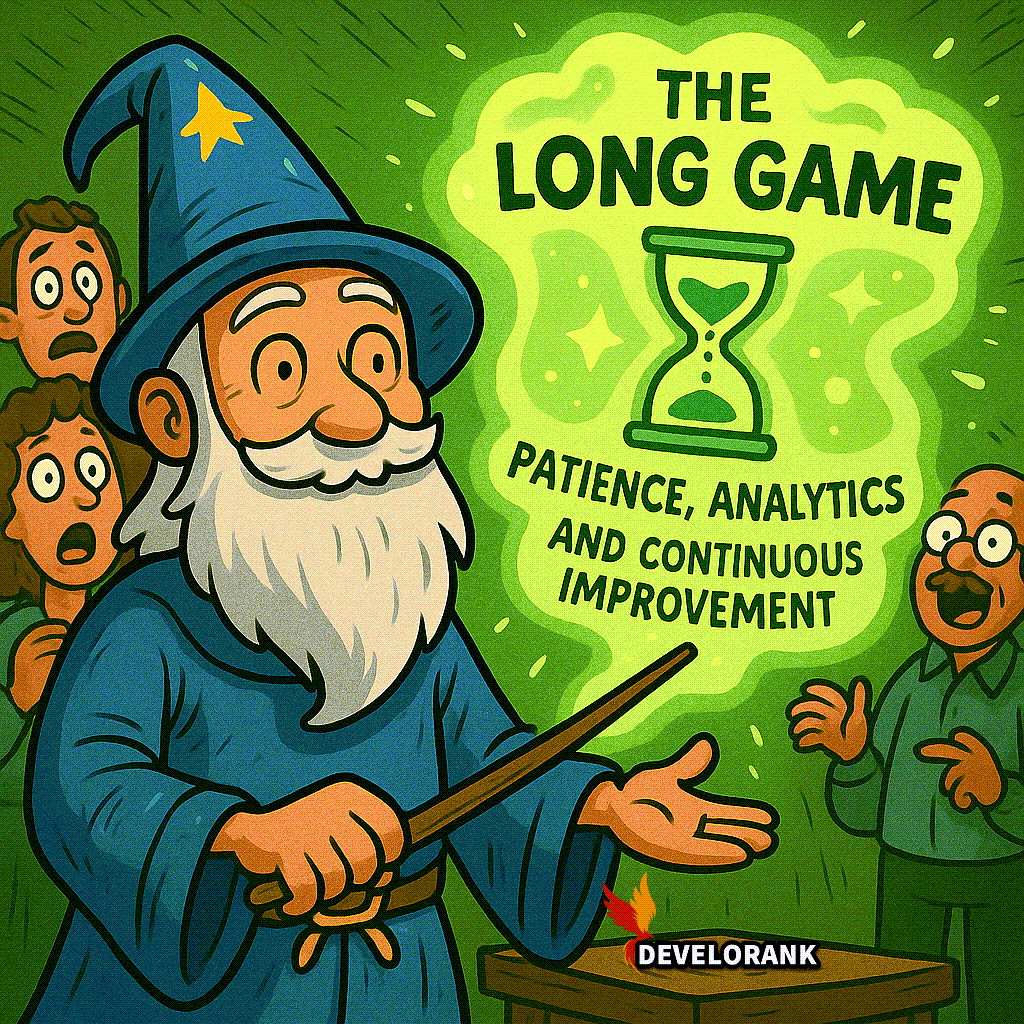
⏳ The Long Game: Patience, Analytics, and Continuous Improvement
Achieving significant ranking without backlinks is not an overnight trick; it’s a long-term strategy built on quality and consistency. It’s more like gardening than flipping a switch. You plant the seeds with solid technical SEO, nurture them with exceptional content, and prune and water them with on-page optimization and user signal analysis. Then, you must have the patience to let them grow. Seeing results can take several months, especially for a new website. The key is to embrace this as an iterative process of publishing, analyzing, and refining your approach over time.
📊 Your Compass: Using Google Search Console & Analytics
You cannot improve what you do not measure. Google Search Console (GSC) and Google Analytics (GA) are your two most critical tools. They are your compass and your map. Google Analytics tells you what users do once they are on your site—which pages they visit, how long they stay, and where they come from. Google Search Console tells you how your site performs in Google Search—which queries you’re ranking for, what your CTR is, and whether Google is encountering any technical issues with your site. Regularly monitoring these tools is essential. GSC, in particular, is a goldmine for this strategy, as it shows you exactly what people are searching for when they find you.
🔄 The Content Refresh Cycle: Keeping Your Assets Evergreen
The digital world is not static. Information becomes outdated, statistics change, and new best practices emerge. A crucial part of this long-term strategy is the content refresh. Periodically review your most important pages. Is the information still accurate for 2025? Can you add new data, examples, or insights? Can you improve the formatting or add a new video? Updating and republishing an old article with a new “last updated” date sends a freshness signal to Google, which can provide a significant ranking boost. It shows that you are actively maintaining your content as a valuable, up-to-date resource.
🔎 Identifying “Striking Distance” Keywords for Quick Wins
In Google Search Console, you can filter your performance report to find keywords where you are already ranking, but not at the top—for example, positions 8 through 20. These are your “striking distance” keywords. Your page is already considered relevant by Google, but it just needs an extra push to get onto page one. Go back to these pages and re-optimize them. Can you improve the title tag? Add a new section that answers a related question? Build a few more internal links to it from other pages on your site? Focusing your efforts on these pages can often yield much faster results than trying to rank for a brand new keyword from scratch.
Here is a list of essential (and mostly free) tools for this strategy:
- 📡 Google Search Console: For performance monitoring and technical health.
- 📈 Google Analytics: For understanding user behavior on your site.
- ⚡ Google PageSpeed Insights: For testing and improving Core Web Vitals.
- 📱 Google’s Mobile-Friendly Test: To ensure your site works on all devices.
- ❓ AnswerThePublic / AlsoAsked: For content idea generation and finding user questions.
- 📝 Google Docs / Hemingway App: For writing clear, readable content.
✅ Your Blueprint for Backlink-Free Ranking Is Ready
We’ve journeyed through the intricate, yet controllable, world of ranking without backlinks. It’s clear that this is not a shortcut, but a commitment to excellence. It’s about building a digital property so valuable and user-friendly that search engines can’t help but take notice. You now have the blueprint. It begins with an unshakeable technical foundation, ensuring your site is fast, secure, and accessible. It’s powered by a kingdom of comprehensive, authoritative content that aims to be the definitive answer for your audience. It’s refined by meticulous on-page optimization, where every title, heading, and internal link works in concert to signal relevance. Finally, it’s validated by the very users you seek to serve, through engagement signals that prove your worth to Google.
Embrace this as your new philosophy. Shift your resources from chasing external validation to perfecting your internal assets. Focus on what you can control: the quality of your code, the depth of your content, and the experience of your users. While the rest of the world is fighting for links, you’ll be building an unshakeable fortress of authority, one perfectly optimized page at a time. The path is clear. The tools are at your disposal. Your journey to the top of the SERPs starts now.
🤔 Frequently Asked Questions (FAQ)
Can you really reach page one without any backlinks?
Yes, it is absolutely possible, especially for low-to-medium competition keywords. By focusing intensely on creating the best content, perfecting on-page SEO, ensuring flawless technical health, and maximizing user engagement signals, you can prove your page’s value directly to Google. For highly competitive terms, it’s more challenging, but a strong on-site foundation is still the essential first step before any link building would be effective.
How long does it take to rank without building links?
Patience is key. This is a long-term strategy. For a new site following these principles, you might start seeing initial traction in 3-6 months, with more significant results appearing around the 6-12 month mark. The timeline depends heavily on your niche’s competitiveness, your content production consistency, and how well you execute the on-page and technical elements. It’s a marathon, not a sprint, focused on sustainable growth.
What’s more important: content or technical SEO?
They are two sides of the same coin and are both critical. Think of it this way: technical SEO is the strong foundation and sturdy walls of a house, while content is the beautiful, functional interior. You cannot have one without the other. The world’s best content won’t rank if Google can’t crawl or index the site properly. Likewise, a technically perfect site with thin, unhelpful content offers no value to users.
Are internal links a substitute for backlinks?
Not directly, as they serve different primary functions. Backlinks (external) are votes of confidence from other websites, signaling broad authority. Internal links distribute authority you already have throughout your own site and establish a clear information hierarchy for users and search engines. A strong internal linking structure is crucial for maximizing your site’s existing power and is a key tactic for ranking without relying on external links.
Is this strategy suitable for highly competitive keywords?
For the most competitive keywords in the world (e.g., “credit cards”), ranking without a strong backlink profile is extremely unlikely. However, this strategy is the *prerequisite* to competing for those terms. You must first build a site that is technically perfect and has the best content on the subject. This foundation makes any future link-building efforts exponentially more effective and may allow you to rank for many less competitive, long-tail variations.
Does Google penalize sites with no backlinks?
No, Google does not penalize a site for having no backlinks. A lack of backlinks simply means the site hasn’t yet earned those external signals of authority. A new, high-quality website will naturally start with zero backlinks. Google’s systems are designed to evaluate content on its own merits. You are not at a disadvantage for being new, only for having poor quality, which this entire strategy is designed to avoid.
What is the first step to start ranking without backlinks?
The absolute first step is a thorough technical SEO audit. Before you even think about content, you must ensure your site is fast, mobile-friendly, secure (HTTPS), and easily crawlable by Google. Use tools like Google PageSpeed Insights and run your site through the Mobile-Friendly Test. Fix any foundational issues first. Building on a broken foundation is a waste of time and resources, so start with the bedrock of technical health.