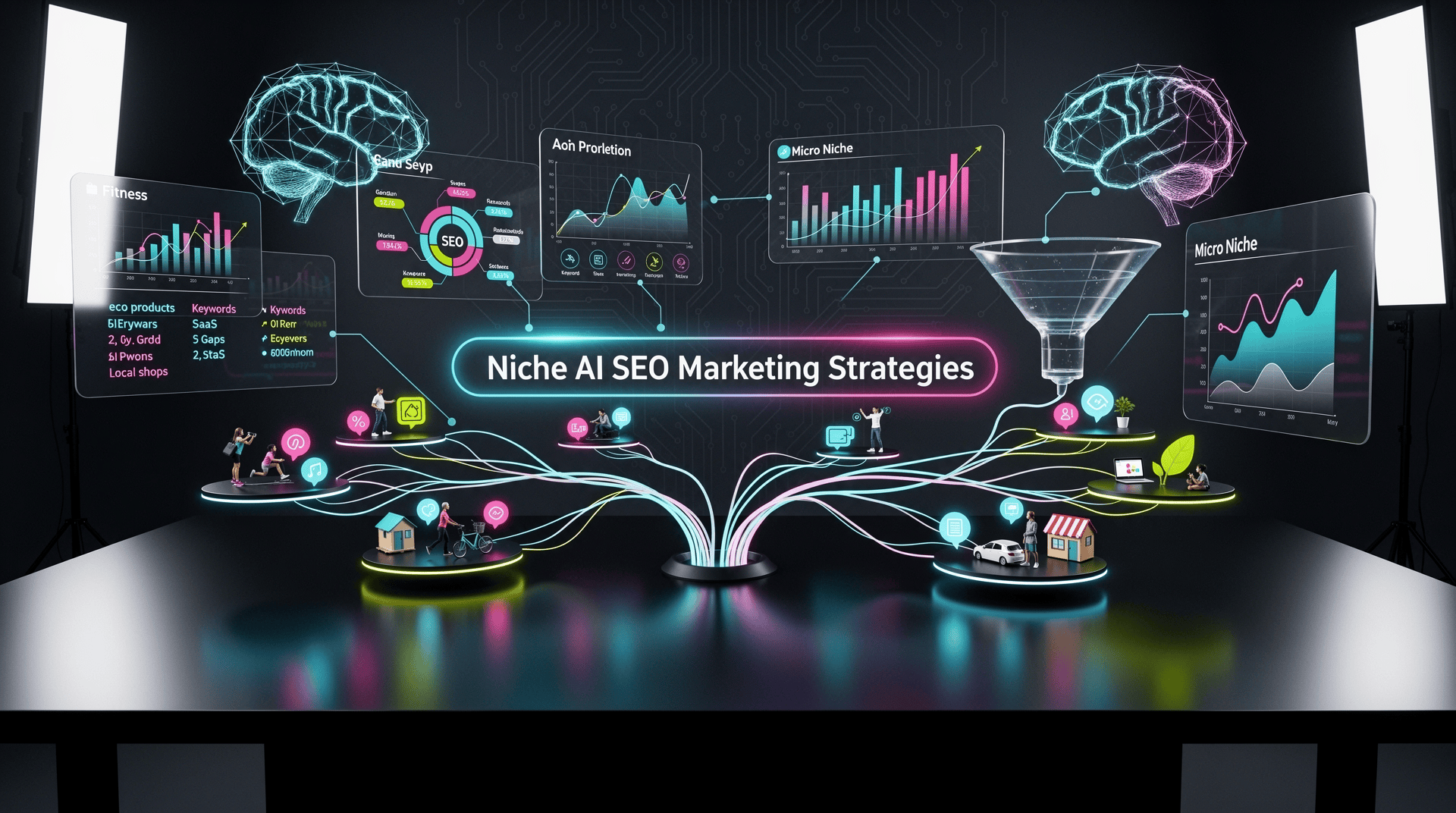
Niche AI SEO Marketing Strategies: Hyper-Focused Optimization
Niche AI SEO marketing strategies involve using artificial intelligence to identify, target, and dominate small, highly specific market segments. This approach moves beyond broad keyword targeting to focus on underserved user needs. Key technologies like OpenAI's GPT-4 and Anthropic's Claude 3 are used to analyze vast datasets from forums, reviews, and social media to uncover hidden opportunities.
Core components include AI-driven hyper-niche identification, programmatic SEO for content scaling, and semantic topic clustering. Tools such as Semrush and Ahrefs provide the foundational data, which AI then refines into actionable insights. This allows marketers to create content that perfectly matches user micro-intents, leading to higher rankings and conversion rates in less competitive search landscapes.
The rise of Google's AI Overviews and Search Generative Experience (SGE) makes these strategies critical. By creating deeply authoritative and comprehensive content for narrow topics, businesses can position themselves as the definitive source, increasing their chances of being featured in these AI-powered search results and capturing highly qualified traffic.
🚀 Beyond Broad Strokes: Why Generic SEO Fails in Niche Markets
The application of generic SEO advice to a specialized market is like using a sledgehammer to perform surgery. It's clumsy, ineffective, and often causes more harm than good. Effective niche AI SEO marketing strategies require a fundamental shift in thinking, moving from a volume-based approach to one of precision and deep relevance. For years, the dominant SEO narrative focused on high-volume keywords and broad authority. This model is breaking down for smaller players trying to gain a foothold in crowded markets.
Big brands with massive budgets can afford to target head terms like "coffee beans" or "running shoes." They have the domain authority and resources to compete on this grand scale. For a niche business, such as one selling single-origin, shade-grown coffee from a specific region in Guatemala, targeting "coffee beans" is a recipe for invisibility. Your potential customers aren't just looking for coffee, they are looking for an experience, a story, and a specific set of attributes that mass-market products cannot offer. This is where the true power of AI enters the picture. It's not just a content-writing robot, it's a market intelligence engine.
Artificial intelligence provides the tools to dissect a broad market into its constituent micro-niches with surgical precision. It can analyze thousands of conversations on Reddit, specialty forums, and product reviews to identify the exact language, pain points, and desires of a specific audience. These niche AI SEO marketing strategies are not about outspending the competition, they are about out-thinking them. By understanding the nuanced search intent behind queries like "low-acidity Guatemalan coffee for cold brew," you can create content that serves a user need so perfectly that Google has no choice but to rank it. This article will provide the blueprint for leveraging AI to discover, scale, and dominate these profitable micro-territories.
🔬 How Do You Use AI for Hyper-Niche Identification?
Finding a truly untapped niche is the holy grail for many marketers. Before AI, this process involved manual grunt work, intuition, and a fair bit of luck. Now, you can deploy AI as a relentless market research analyst that never sleeps. The core principle is to feed large language models (LLMs) unstructured data from the places your potential customers congregate online and ask it to find patterns.
Start by identifying the digital watering holes for your broad topic. For a niche like "custom mechanical keyboards," this would be subreddits like r/MechanicalKeyboards, Discord servers, geekhack.org forums, and YouTube comment sections. Manually reading through thousands of posts is impossible. Instead, you can use scraping tools (ethically and within terms of service) or APIs to gather this text data. Once you have a corpus of conversations, the real work begins. You can use an LLM like GPT-4 or Claude 3 to perform thematic analysis at a massive scale.
🤖 Prompting for Profit: Uncovering Hidden Opportunities
The quality of your output depends entirely on the quality of your prompts. Instead of asking generic questions, you need to instruct the AI to act as a specific persona. For example:
"You are a market research analyst specializing in consumer hobbies. I will provide you with 1,000 comments from a forum about mechanical keyboards. Your task is to identify and cluster recurring problems, desires, and questions that are not adequately addressed by major brands. Categorize these into potential product or content sub-niches. Look for phrases like 'I wish there was…', 'Does anyone know how to…', or 'I can't find a…' and present the top 10 most promising micro-niches with supporting evidence from the text."
This type of prompt forces the AI to move beyond summarization and into synthesis. It might uncover a sub-niche for "silent mechanical keyboards for open-plan offices" or "ergonomic split keyboards for users with RSI." These are hyper-specific niches with clear user pain points, making them perfect targets for niche AI SEO marketing strategies. The AI can also identify the specific jargon and semantic terms used by the community, providing a ready-made list of LSI keywords for your content.
✍️ What Is Programmatic SEO for Niche Content Scaling?
Once you have identified a dozen promising micro-niches, the challenge becomes creating high-quality, targeted content for each without spending months writing. This is where programmatic SEO (pSEO), supercharged by AI, becomes a game-changer. Programmatic SEO is the method of creating pages at scale by using a database and a template. Think of how Zillow creates a unique page for every address or how Yelp creates one for every business.
The traditional pSEO model has a weakness: the content can feel thin and repetitive if the variable data isn't rich enough. This is where AI transforms the process. Instead of just plugging in a city name or a product spec, you can use AI to generate unique, contextually relevant paragraphs for each variable. This elevates pSEO from a simple mail-merge operation to a sophisticated content generation engine.
📈 The AI-Enhanced Programmatic Workflow
Imagine you run a niche site about sustainable gardening. You've identified a pSEO opportunity around the query "best companion plants for [vegetable]."
- 🌱 Step 1: Build Your Database. Your database would have a list of vegetables (tomato, cucumber, peppers). But instead of just that, you add columns for 'Common Pests', 'Soil Needs', and 'Sunlight Requirements'.
- 🤖 Step 2: Generate AI Variables. For each vegetable, you use an AI prompt: "For a [vegetable], write a 50-word paragraph explaining why companion planting is particularly beneficial, mentioning its specific vulnerabilities like [Common Pests]." The AI generates a unique, helpful paragraph for every single vegetable in your database.
- 📄 Step 3: Create Your Template. You design a page template with placeholders for ``, ``, and a list of its best companion plants.
- 🚀 Step 4: Publish at Scale. You use a tool or script to combine the database and template, instantly generating hundreds of unique, valuable pages like "Best Companion Plants for Tomatoes" and "Best Companion Plants for Bell Peppers."
This method allows you to achieve a level of authority and coverage in a niche that would be manually impossible. Each page is genuinely helpful because the AI-generated content addresses the specific context of the query. For more on scaling content responsibly, Google's own guidelines on creating helpful content are an essential read.
🧠 Can AI Build a Semantic Content Silo for You?
Ranking in a competitive niche isn't just about individual pages, it's about demonstrating comprehensive topical authority. Search engines want to see that you are an expert on a subject. The most effective way to signal this expertise is by building a content silo or topic cluster, a tightly interlinked group of pages covering a single topic in exhaustive detail. Manually planning these clusters is a complex, time-consuming process. AI can act as your SEO architect, designing the entire blueprint in minutes.
A topic cluster consists of a main "pillar page" covering the broad topic (e.g., "A Beginner's Guide to Sourdough Baking") and numerous "cluster pages" that target specific, long-tail keywords related to that topic (e.g., "how to feed a sourdough starter," "best flour for sourdough bread," "troubleshooting a flat sourdough loaf"). The pillar page links out to all the cluster pages, and each cluster page links back to the pillar. This structure tells search engines that you have deep knowledge of the subject.
Using an LLM, you can automate the entire discovery and planning phase. Start with a simple prompt:
"I am creating a topic cluster for the pillar topic 'Indoor Hydroponic Gardening.' Act as an expert SEO strategist. Generate a list of 20 essential cluster content ideas that a beginner would search for. For each idea, provide a target long-tail keyword, a list of 5-7 semantic LSI keywords, and 3-4 key user questions that the article must answer."
The AI will return a structured content plan that you can hand directly to your writers or even use as a basis for further AI-assisted content generation. It will identify entities (e.g., 'Nutrient Film Technique,' 'Kratky method,' 'pH levels') and question-based queries that are perfect for targeting "People Also Ask" boxes and featured snippets. This is one of the most powerful niche AI SEO marketing strategies for building authority quickly and efficiently. The AI can even suggest the optimal internal linking structure, telling you exactly which pages should link to each other to maximize the flow of PageRank and semantic relevance.
📊 How Does AI Refine Niche Keyword Intent Analysis?
Traditional keyword intent is often bucketed into four simple categories: informational, navigational, transactional, and commercial investigation. While useful, this model is too simplistic for the complexities of niche markets. A user's true intent is far more nuanced. AI allows us to dissect search queries and SERP data to understand the 'micro-intent' behind the search, enabling the creation of content that is uncannily relevant.
For example, within the broad 'informational' category for a niche like "vintage watch restoration," there are dozens of micro-intents. AI can help you distinguish between them by analyzing the language of the query and the characteristics of the top-ranking pages. You can feed an LLM a list of keywords and the corresponding SERP data (titles, descriptions, page types) and ask it to classify them into more granular categories.
Here are some of the micro-intents that AI can help you identify and target within a niche:
- 🔧 DIY Troubleshooting Intent: Queries like "Seiko 7s26 movement running fast." The user wants a step-by-step guide with diagrams or a video.
- 🤔 Validation-Seeking Intent: Searches such as "Is a vintage Omega Seamaster a good investment?" The user has likely already made a decision and is looking for expert content to confirm their choice.
- ⚖️ Nuanced Comparison Intent: Beyond "Product A vs. Product B." This includes queries like "Rolex Submariner vs. Tudor Black Bay for daily wear." The context ('for daily wear') is the key, and your content must address it directly.
- 🌍 Ethical/Sourcing Intent: Common in niches like food, fashion, and cosmetics. Queries like "ethically sourced lab-grown diamonds" require content about brand values, certifications, and supply chain transparency.
- 💰 Budget-Constrained Intent: Searches like "best automatic watch under $300." The content needs to focus on value, durability, and features within a strict price point.
By tailoring your content's angle, tone, and format to these micro-intents, you create a superior user experience. This leads to higher engagement signals (dwell time, lower bounce rate) which are powerful ranking factors. This level of precision is a cornerstone of advanced niche AI SEO marketing strategies and provides a significant competitive advantage over those still operating with the old, broad-intent model.
🔗 What Are AI-Powered Link Building Strategies for Niches?
Link building in a niche market is about quality, not quantity. A single, contextually relevant backlink from an authoritative blog in your niche is worth more than a hundred generic directory links. The challenge is finding these high-value opportunities and crafting outreach that gets a response. AI can automate the most laborious parts of this process, freeing you up to build genuine relationships.
Forget sending thousands of generic email blasts. Use AI for precision targeting. Start by identifying the 'link leaders' in your niche, the sites that consistently attract backlinks from other authoritative sources. You can use tools like Ahrefs or Semrush to pull a list of sites that link to your top 3-5 competitors but not to you. This is your 'link gap' analysis.
Once you have this list of prospects, AI can help you qualify and personalize your outreach at scale. You can use AI models to:
- 🎯 Qualify Prospects: Feed the AI a list of URLs and ask it to categorize them based on relevance, estimated authority (based on language and site type), and whether they accept guest posts or have broken links.
- ✍️ Personalize Outreach: Use an LLM with access to the web (or by providing it with the content of a prospect's recent article) to generate a personalized opening line for your outreach email. Prompt: "Read this article at [URL] and write a single, genuine sentence complimenting a specific point the author made." This instantly elevates your email above the 99% of generic templates.
- 💡 Brainstorm Linkable Assets: Use AI to analyze the most linked-to content in your niche. Ask it, "Analyze the top 10 most linked-to articles about [your niche]. What formats are most successful (e.g., data studies, ultimate guides, free tools)? What topics are covered? Now, suggest 5 ideas for a linkable asset that offers a new angle or more current data." This helps you create content that is engineered to attract links from the start.
This AI-assisted approach combines the scale of automation with the personal touch required for effective link building. It's a prime example of how niche AI SEO marketing strategies allow you to work smarter, not just harder, to build your site's authority.
🤖 How Can You Automate On-Page SEO Audits with AI?
Maintaining perfect on-page SEO across a growing niche site can be a daunting task. As you add more content, especially through programmatic methods, it's easy for issues like missing alt text, duplicate meta descriptions, or broken internal links to creep in. AI, particularly through custom scripts, can act as your vigilant on-page SEO manager, constantly auditing your site and flagging issues before they impact your rankings.
While tools like Screaming Frog are excellent, you can create even more customized audits using Python in combination with AI APIs. A Python script using libraries like `BeautifulSoup` and `Requests` can crawl every page of your site. For each page, it can extract the key on-page elements: title tag, meta description, H1, image alt text, and all outgoing links.
This data can then be piped to an AI model for analysis. Here's what this AI-powered audit can do that a standard crawler can't:
- 🔍 Semantic Title & Meta Analysis: Instead of just checking for length, the AI can analyze if your title tag and meta description are compelling and accurately reflect the main content of the page. It can even score them for click-through rate (CTR) potential and suggest better alternatives.
- 🖼️ Contextual Alt Text Generation: If an image is missing alt text, a multimodal AI model can 'look' at the image and generate a descriptive, keyword-rich alt tag that is far better than a generic filename.
- 🔗 Internal Linking Opportunities: The AI can read the full text of a page and, based on its understanding of your entire site's content structure, suggest relevant internal links to other pages that you may have missed. Prompt: "Read this article text. Based on the sitemap provided, what are the 3 most relevant internal linking opportunities?"
- 🧐 Thin Content Detection: The AI can analyze the word count and the semantic depth of a page to flag it as potential 'thin content' that needs to be expanded or improved to provide more value to the user.
Setting up a script to run this audit weekly can save dozens of hours of manual work and ensure your site remains technically sound as it scales. This proactive maintenance is a crucial part of a mature niche AI SEO marketing strategies portfolio.
| ⚙️ Aspect | 🚶 Manual Approach | 🚀 AI-Enhanced Approach |
|---|---|---|
| Data Sourcing | Manually compiling spreadsheets with basic variables (names, locations). | AI analyzes sources to extract nuanced data and generate unique descriptive text for each entry. |
| Content Variation | Relies on simple 'spin tax' or repetitive sentence structures. High risk of duplication. | Generates genuinely unique paragraphs, introductions, and conclusions for each page based on its specific variables. |
| Scalability | Limited by the time it takes to manually source high-quality data. | Can scale to thousands of pages quickly, as AI can enrich a basic dataset automatically. |
| Quality Control | Manual spot-checking, which is prone to error and time-consuming. | AI can be used to audit the generated pages for quality, tone, and factual accuracy before publishing. |
🔮 What Are the Future Trends in Niche AI SEO?
The integration of AI into SEO is not a fleeting trend, it is the new foundation. For niche marketers, staying ahead of the curve is essential for survival and growth. As we look toward the near future, several key trends are emerging that will further shape the landscape of niche AI SEO marketing strategies. Understanding and preparing for these shifts will separate the leaders from the laggards.
First, **Predictive SEO** will become more accessible. AI models will be able to analyze historical search trends, social media chatter, and news data to forecast which sub-niches are about to gain popularity. Imagine knowing that a niche hobby is about to go viral weeks before it hits the mainstream, giving you time to build out a full content cluster and capture the first wave of search traffic. This moves strategy from reactive to proactive.
Second, **Generative Engine Optimization (GEO)** will become a dedicated discipline. This is the practice of optimizing content not just for traditional blue links, but to be the source material for AI-powered search answers like Google's AI Overviews. This requires a focus on creating extremely clear, well-structured, factually dense content that an AI can easily parse and synthesize. Niche sites are perfectly positioned for this, as their depth of expertise on a narrow topic makes them a more trustworthy source than a generalist site. For more on this emerging field, the community at Search Engine Land often features cutting-edge analysis.
Finally, **Hyper-Personalization** will move from e-commerce giants to niche websites. AI will enable the real-time customization of website content based on a user's location, past behavior, and referral source. For a niche travel blog, this could mean showing a user from Canada content about 'best hiking trails accessible from Toronto' while showing a user from the UK content about 'top UK hiking spots,' all on the same URL. This level of personalization creates an unparalleled user experience and dramatically increases conversion rates. These future trends all point to a more intelligent, precise, and user-centric approach to SEO, a domain where niche marketers have a natural advantage.
✅ Your Blueprint for AI-Driven Niche Dominance
Embracing niche AI SEO marketing strategies is no longer an option, it is a necessity for anyone looking to build a sustainable and profitable online presence in a specialized market. We've moved past the simple application of AI for drafting blog posts. The true competitive edge lies in using artificial intelligence as a strategic partner across the entire SEO workflow.
The core takeaways form a powerful blueprint for success. It begins with using AI for **hyper-niche identification**, turning the firehose of online conversations into a precise map of underserved customer needs. From there, you can employ **AI-assisted programmatic SEO** to scale your content creation, building authority across dozens of micro-topics at a speed and quality previously unimaginable. This content should be organized into **semantic topic clusters**, also designed by AI, to signal deep expertise to search engines.
This foundation is supported by a more nuanced understanding of **user micro-intent** and a precision-guided **link building** process, both refined and accelerated by AI. Finally, ongoing **automated on-page audits** ensure your growing digital asset remains technically flawless. By integrating these strategies, you are not just keeping up, you are building a moat around your niche that is difficult for larger, less agile competitors to cross. The question is no longer if you should use AI in your SEO, but how deeply you are willing to integrate it to secure your market position?
Frequently Asked Questions About Niche AI SEO Marketing Strategies
What is the main advantage of using AI for niche SEO?
The primary advantage is precision and scale. AI can analyze vast amounts of data to identify hyper-specific user needs and content gaps that are invisible to manual research, allowing you to target underserved audiences with unparalleled accuracy.
Can AI replace my SEO team for niche marketing?
No, AI is a powerful tool, not a replacement for human strategy. It automates repetitive tasks and provides deep insights, but human expertise is still required to set the strategy, interpret the data, and build genuine relationships for link building.
Is programmatic SEO considered spam by Google?
It can be, if done poorly. High-quality programmatic SEO that uses unique, valuable data and AI-generated text to create genuinely helpful pages is not considered spam. The key is to provide unique value on every page, not just change a single word.
What's the best AI tool for niche keyword research?
There isn't one single 'best' tool. The most powerful approach combines traditional SEO tools like Ahrefs or Semrush for data with large language models like GPT-4 or Claude 3 for analysis, pattern recognition, and uncovering user intent from raw text data.
How much does implementing niche AI SEO strategies cost?
Costs can vary widely. It can be as low as the subscription fees for AI models and SEO tools if you have the technical skills to implement them yourself. For more complex programmatic projects or custom scripts, development costs can range from hundreds to thousands of dollars.
How do I start with AI in my SEO workflow?
Start small. Use an AI tool like ChatGPT to brainstorm content ideas for a topic cluster or to refine the meta descriptions for your top 10 pages. This allows you to get comfortable with the technology and see immediate value before committing to larger, more complex projects.