🎯 Searcher Intent Meets AI: Why Generative Engine Optimization Strategies Matter Now
Generative engine optimization strategies are no longer a novelty—they are the control panel for how AI systems surface, summarize, and recommend your brand in 2025. If your buyers are increasingly getting answers from AI over traditional search, your visibility now depends on how well your content is understood by large language models (LLMs), retrieval pipelines, and AI assistants. This shift is subtle yet seismic: the algorithm isn’t just scoring keywords anymore; it’s composing answers. And your brand can either be quoted or quietly omitted.
🧭 The core search intent behind generative engine optimization strategies is informational and commercial investigation. Readers want to know exactly how to make their content discoverable in AI answers, how to engineer pages for LLM comprehension, and how to measure success when the click is no longer the only outcome. They need a system, not slogans.
💡 Think of LLMs like expert librarians with photographic memory and a talent for storytelling. They retrieve, reason, and generate. The way you structure content, define entities, provide verified context, and craft on-page cues now shapes not just rank, but the very sentences models write about you. That makes generative engine optimization strategies a blend of technical SEO, knowledge engineering, and narrative design.
⚙️ This article gives you a playbook: how models parse your site, how to make your facts retrievable, how to package proofs and citations, how to architect internal links for passage-level retrieval, and how to measure AI-driven exposure even when traffic isn’t the endgame. You’ll leave with a 90-day plan, measurement frameworks, and a scalable content specification tuned for AI answers.
🧠 Audience Psychology & NLP Alignment: Tuning Content to Your Readers and the Model
Generative engine optimization strategies work best when they speak to two audiences at once: human readers with specific anxieties and goals, and LLMs that convert your words into embeddings and answers. The bridge is NLP alignment—how your semantics, intent structure, and evidence map into the model’s representation.
🧭 Primary Search Intent Analysis
📌 People searching this topic want a reliable blueprint. They’re evaluating frameworks, workflows, and metrics—clarity beats hype. They expect specifics: content architecture, schema, entity mapping, RAG-friendly formatting, and how to get featured in AI summaries. Generative engine optimization strategies should minimize fluff and maximize replicable steps.
👤 Reader Avatar: The AI-Focused Growth Lead
🧑💼 Role: Head of SEO, Content Ops leader, Product Marketing, or Tech Founder at a growth-stage company. They’re analytical, systems-driven, and impatient with vague guidance.
- 📉 Pain points: SGE cannibalizing clicks, inconsistent AI answers, lack of clear GEO KPIs.
- 🧩 Needs: Scalable playbook, governance, fast iteration cycles, model-safe content patterns.
- 🛠 Tooling: Analytics, vector databases, schema validators, prompt test harnesses.
🗣 Language Patterns That Increase Retrieval Odds
🧩 LLMs latch onto crisp definitions, labeled sections, and explicit claims supported by citations. Use hierarchies that signal “answer blocks.” Include evidence statements, verifiable metrics, and canonical entity names. Generative engine optimization strategies benefit from content that reads like a structured brief—clear headers, tight paragraphs, and embedded proofs.
⚙️ Inside the Black Box: How Generative Engines Parse Your Site
To execute generative engine optimization strategies, you need a mental model for how AI systems process content. While implementations vary, most pipelines share patterns: crawl → parse → chunk → embed → index → retrieve → rerank → generate → cite. Each step is a lever you can influence.
🧩 Chunking and Embeddings
🧠 Content is split into semantic chunks (100–400 tokens is common), then converted into embeddings—high-dimensional vectors capturing meaning. Retrieval matches user intent vectors to your content vectors. If your sections are bloated, unlabelled, or mixed-topic, your relevance score drops. Generative engine optimization strategies thrive on clean, well-labeled, single-intent passages.
📚 Reranking and Answer Composition
🔎 Top-k retrieval brings candidate passages; rerankers (often cross-encoders) pick the best few. The generator composes an answer, optionally constrained by system prompts, grounding policies, and citation rules. Your job: make each passage irresistibly quotable—concise definition, supporting evidence, and explicit relevance to the query. Generative engine optimization strategies often fail when evidence is implied rather than stated.
For foundational background on the architectures powering this shift, review the transformer model overview at the Transformer architecture on Wikipedia. Understanding attention mechanisms helps explain why tight, labeled passages outperform meandering prose.
🗂 Information Architecture That Wins Passage-Level Retrieval
Generative engine optimization strategies reward sites that mirror how LLMs organize knowledge. Think “card catalogs,” not “walls of text.” Your IA should create clear pathways from entity pages to task pages to proof pages—each link strengthening retrieval signals.
🧱 Section Design for Quotable Passages
- 🧷 Start sections with a one-sentence answer, followed by a 3–6 sentence expansion.
- 🏷 Add labels: “Definition,” “Process,” “Metric,” “Risk,” “Example,” “Checklist.”
- 🔗 Link to evidence: internal research, third-party authorities, data snapshots.
- 🧭 Keep each section single-intent to improve embedding coherence.
🔗 Internal Links as Retrieval Hints
🪤 Internal anchors work like breadcrumbs for models. Use descriptive anchor text pointing to canonical answers. When multiple pages mention the same concept, consolidate with a master entity page and route internal links there. Generative engine optimization strategies work best when link graphs reflect concept hierarchies, not navigation compromises.
📦 Content Specifications (Content Spec 2.0)
📐 Define a site-wide content spec: target questions, passage lengths, schema types, evidence requirements, and update cadence. Create “answer blocks” that can be reused across formats. This operationalizes generative engine optimization strategies so every contributor ships model-ready content.
🔍 Prompting the Page: On-Page Elements That Steer Model Outputs
Generative engine optimization strategies extend on-page SEO into prompt engineering. You’re not only optimizing for CTR—you’re guiding how models interpret and quote your content.
🏷 Titles, Intros, and Summaries as System Prompts
🪄 Titles with explicit outcomes (“How to…”, “Framework for…”, “Checklist for…”) prime models to frame your page as an instruction source. Opening paragraphs stating the scope and audience function like system prompts, narrowing the model’s angle. Summaries per section act as safety rails.
🗣 Lexical Cues That Increase Quote Likelihood
- 🪪 Use canonical entity names before abbreviations (e.g., “retrieval-augmented generation (RAG)”).
- 📏 Quantify claims (“reduced time-to-answer by 22%”) and timestamp them (“as of 2025”).
- 🧾 Attribute sources inline where possible to enable citation-friendly text.
- 🧩 Group related facts into compact lists that fit within typical token windows.
🧪 On-Page GEO Checklist
- 1️⃣ 🔖 Start with a precise definition or outcome statement.
- 2️⃣ 🧭 Add a one-paragraph summary targeting the main question.
- 3️⃣ 🧷 Break content into single-intent sections labeled with H2/H3.
- 4️⃣ 📚 Include citations and internal evidence links near claims.
- 5️⃣ 🧪 End each section with a short, quotable conclusion sentence.
📚 Entities, Schema, and Knowledge Graph Alignment
Generative engine optimization strategies rely on entities. If the model can’t resolve “who/what/where,” your authority dissolves. Use JSON-LD to define your organization, products, authors, and claims. Align terms with established knowledge graphs and ontologies to reduce ambiguity.
🧾 JSON-LD and Schema Types
🧩 Implement Organization, Person (author), Product/Service, FAQPage, HowTo, and Article schema where appropriate. This creates machine-readable anchors. For official structured data guidance, see Google’s structured data introduction and the JSON-LD specification at W3C’s JSON-LD 1.1.
🧠 Entity Disambiguation Techniques
- 🪪 Use “sameAs” to link to authoritative profiles (LinkedIn, Crunchbase, Wikipedia).
- 🧭 Add geo, industry, and category properties to narrow meaning.
- 🔎 Include curated glossaries mapping synonyms to canonical terms.
- 🧷 Resolve duplicate entities across your site with a single canonical page.
| Schema Type 🧾 | Primary Benefit 🚀 | GEO Impact 🎯 |
|---|---|---|
| Organization | Entity authority and disambiguation | Improves brand mentions in AI summaries |
| Article/FAQPage | Defines Q&A and answer blocks | Boosts passage retrieval and citations |
| Product/Service | Feature and pricing clarity | Better inclusion in comparison answers |
🧩 RAG, Source Hubs, and AI Sitemaps: Feeding Models Verifiable Context
Retrieval-Augmented Generation (RAG) is now table stakes. Even when you don’t control the assistant, you can make your site “RAG-ready.” Generative engine optimization strategies improve dramatically when your content is packaged for retrieval by any system.
🗺 Build a Source-of-Truth Hub
- 🏛 Create a central “facts” hub: definitions, metrics, timelines, and glossaries.
- 🧾 Add short, citation-ready statements next to each fact with timestamps.
- 🔁 Version your facts and keep a public changelog for transparency.
🗂 AI Sitemaps and Clean Feeds
🛰 Provide machine-friendly catalogs (JSON feeds, structured sitemaps) focused on high-value answers, not just pages. Prioritize pages with robust schema, clear answers, and fresh timestamps. Generative engine optimization (GEO) strategies benefit when crawlers find your best content first.
🧪 Implementation Steps
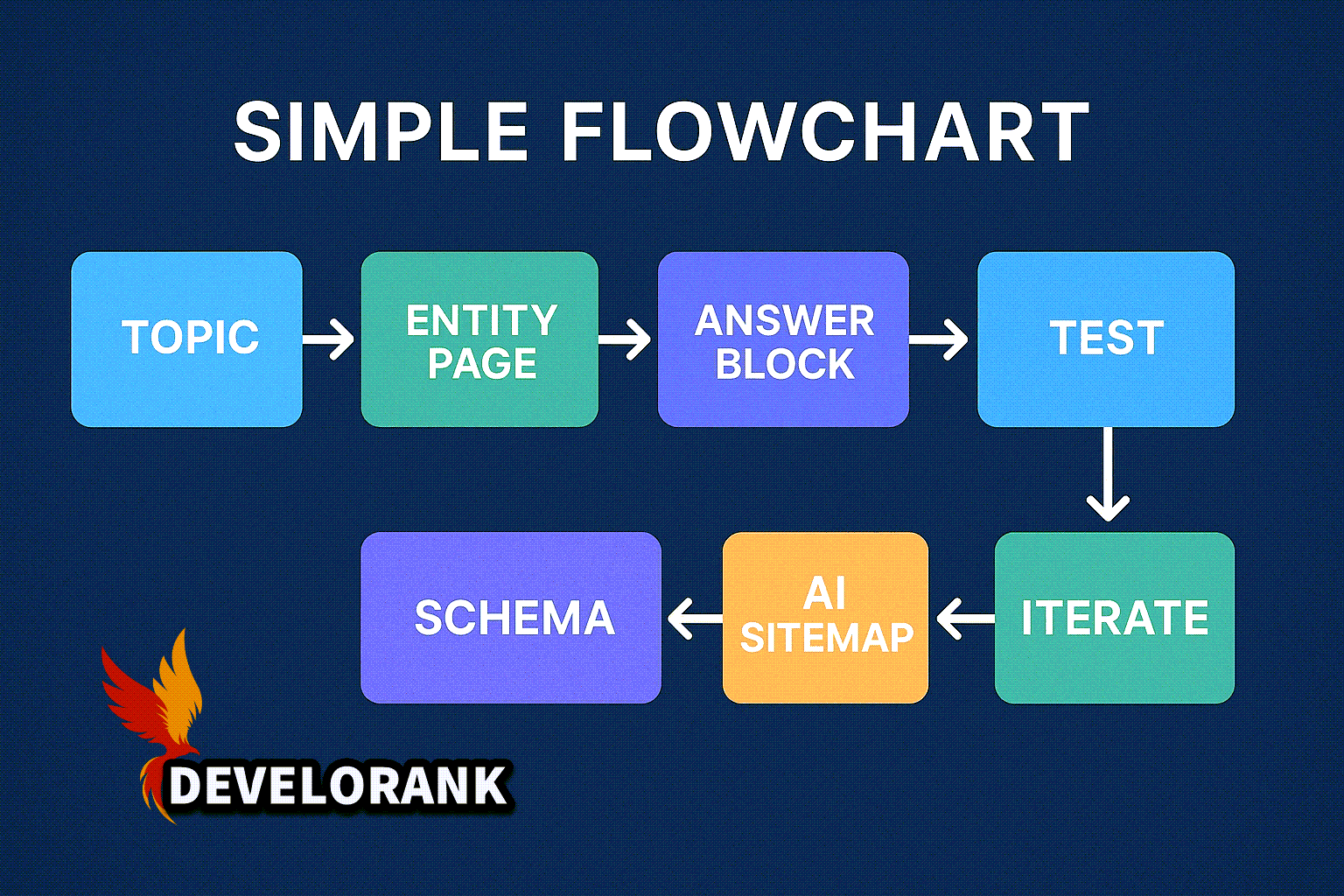
- 1️⃣ 🧱 Create canonical answer pages for core entities and questions.
- 2️⃣ 🛰 Generate a lightweight AI sitemap pointing to those answers.
- 3️⃣ 🧩 Add JSON-LD with sameAs and disambiguation metadata.
- 4️⃣ 🧪 Test retrieval using local RAG with your embeddings.
- 5️⃣ 🔁 Iterate: shorten passages, add citations, and tighten labels.
📈 Measurement That Matters: New KPIs for Generative Visibility
Traditional SEO metrics only tell half the story. Generative engine optimization strategies require instrumentation that tracks exposure inside AI experiences. You need proxies for “answer share,” “citation frequency,” and “time-to-fix hallucinations.”
🧪 GEO KPI Framework
| KPI 📊 | What It Measures 🧭 | Optimization Levers 🛠 |
|---|---|---|
| Answer Inclusion Rate | % of test prompts that cite your domain | Section summaries, citations, schema |
| Passage Retrieval Score | Local RAG: top-k rank of your passages | Chunk size, headings, entity clarity |
| Citation Quality Index | Accuracy and specificity of quoted text | Inline proofs, dated statements |
🧰 Practical Measurement Loop
- 🧪 Build a prompt set covering your top 50 topics and intents.
- 🧮 Score inclusion, accuracy, and narrative framing monthly.
- 🔁 Run ablation tests: adjust chunking, schema, or summaries and re-measure.
- 🕒 Track time-to-correction for reported AI inaccuracies.
🛡 Governance, Risk, and Model-Safe Content Design
Generative engine optimization strategies without governance can backfire. AI will copy your ambiguity, outdated facts, or unclear disclaimers. Model-safe content design anticipates misinterpretations and provides guardrails.
🧱 Create a Fact Policy
- 📆 Timestamp all claims and include update cadence.
- 🧾 Distinguish between research, opinion, and marketing claims.
- 🔎 Provide citations for non-obvious statements.
- 🧯 Publish a corrections page and link it site-wide.
🧩 Legal and Compliance Notes
🧭 Include usage disclaimers where advice could be construed as professional guidance. Mark speculative forecasts clearly. Generative engine optimization strategies benefit when your content reduces the model’s uncertainty and legal risk—models tend to quote sources that sound precise and responsible.
🚀 The 90-Day Operational Playbook for GEO
Here’s a practical rollout to operationalize generative engine optimization strategies without boiling the ocean. Treat it like an optimization sprint with clear deliverables and measurement gates.
📅 Phase 1 (Weeks 1–4): Baseline and Foundations
- 1️⃣ 🔎 Audit top 50 topics; identify entity gaps and duplicate concepts.
- 2️⃣ 🧭 Define content spec: passage size, labels, schema, citation policy.
- 3️⃣ 🧠 Build a prompt test set for monthly tracking.
- 4️⃣ 🧾 Implement Organization and Article schema; add sameAs links.
🏗 Phase 2 (Weeks 5–8): Build Quotable Assets
- 1️⃣ 🧱 Publish entity pages and a “Metrics Library” or “Facts Hub.”
- 2️⃣ 🧷 Rewrite 15 priority articles into single-intent sections.
- 3️⃣ 📚 Add FAQs and short answer boxes to each priority page.
- 4️⃣ 🛰 Create an AI sitemap highlighting these assets.
🔁 Phase 3 (Weeks 9–12): Test, Iterate, Scale
- 1️⃣ 🧪 Run local RAG tests; adjust chunk size and headings.
- 2️⃣ 🧮 Track inclusion and citation quality; fix low-performing pages.
- 3️⃣ 🧭 Document patterns; convert into a team checklist.
- 4️⃣ 🚀 Expand to the next 50 topics with a content factory approach.
🔮 Future-Proofing: Multimodal, Agents, and Voice Interfaces
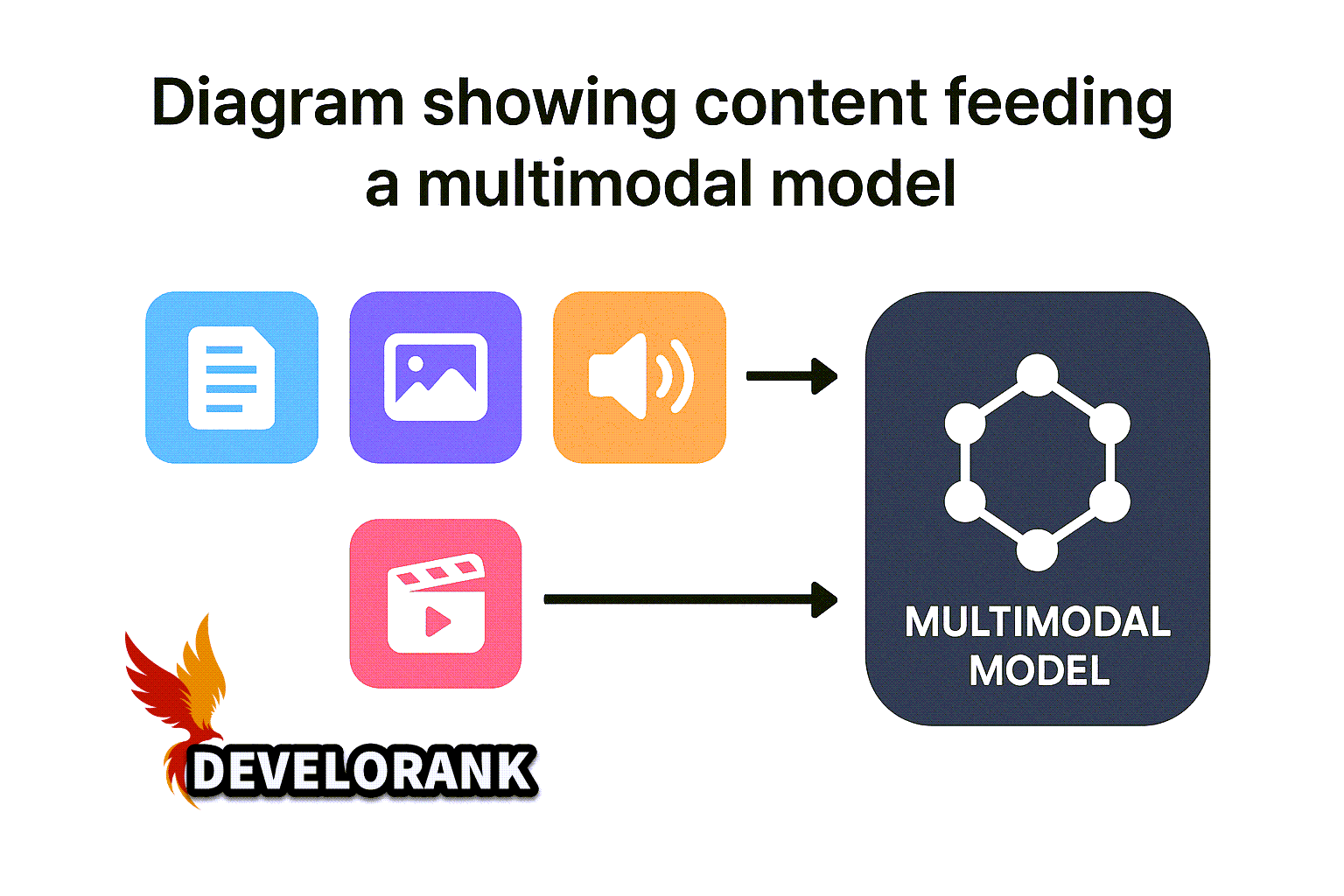
Generative engine optimization strategies are evolving beyond text. Multimodal models ingest images, charts, audio, and even UI flows. Agents perform tasks, not just describe them. Voice interfaces compress answers to 1–2 lines. Your content must be multimodal-ready and agent-friendly.
🖼 Multimodal Readiness
- 🖼 Provide alt text that explains charts and diagrams with units and context.
- 📊 Include data tables with clear headers and captions.
- 🎧 Offer audio summaries for key articles to increase voice surface area.
🤖 Agent-Friendly Content
🧭 Agents need step-by-step instructions, inputs, and constraints. Include procedural checklists and parameter tables so agents can act deterministically. Generative engine optimization strategies will increasingly hinge on how “actionable” your content appears to autonomous systems.
💼 Repeatable Patterns: Scenario Playbooks That Keep Working
Across industries, certain generative engine optimization strategies repeatedly win because they match how LLMs retrieve and compose answers. Use these patterns as templates, then localize.
📘 The Definition + Proof + Path Pattern
🔎 Start with a plain-language definition, provide the top three proofs (data point, external citation, internal case), then offer a path (“how to apply this in 3 steps”). This creates a self-contained answer that models can lift with minimal editing—and cite.
🧰 The Toolkit Table Pattern
🧩 Provide a compact table listing tools, inputs, outputs, and risks. Models love structured contrasts. It’s easy for them to stitch into comparisons without misquoting.
🧭 The Decision Tree Pattern
🪜 Offer a small decision tree with 3–5 branches and specific thresholds (e.g., “If dataset < 10k rows, use X; else Y”). This converts ambiguity into deterministic logic that agents can use.
For broader perspective on AI’s societal and research context—which informs governance and ethics in your content—see Stanford Human-Centered AI. Big-picture awareness helps you craft safer, more durable assets.
🧭 Content Blueprint: The GEO-Ready Article Specification
Use this specification to standardize how your team ships content that supports generative engine optimization strategies at scale.
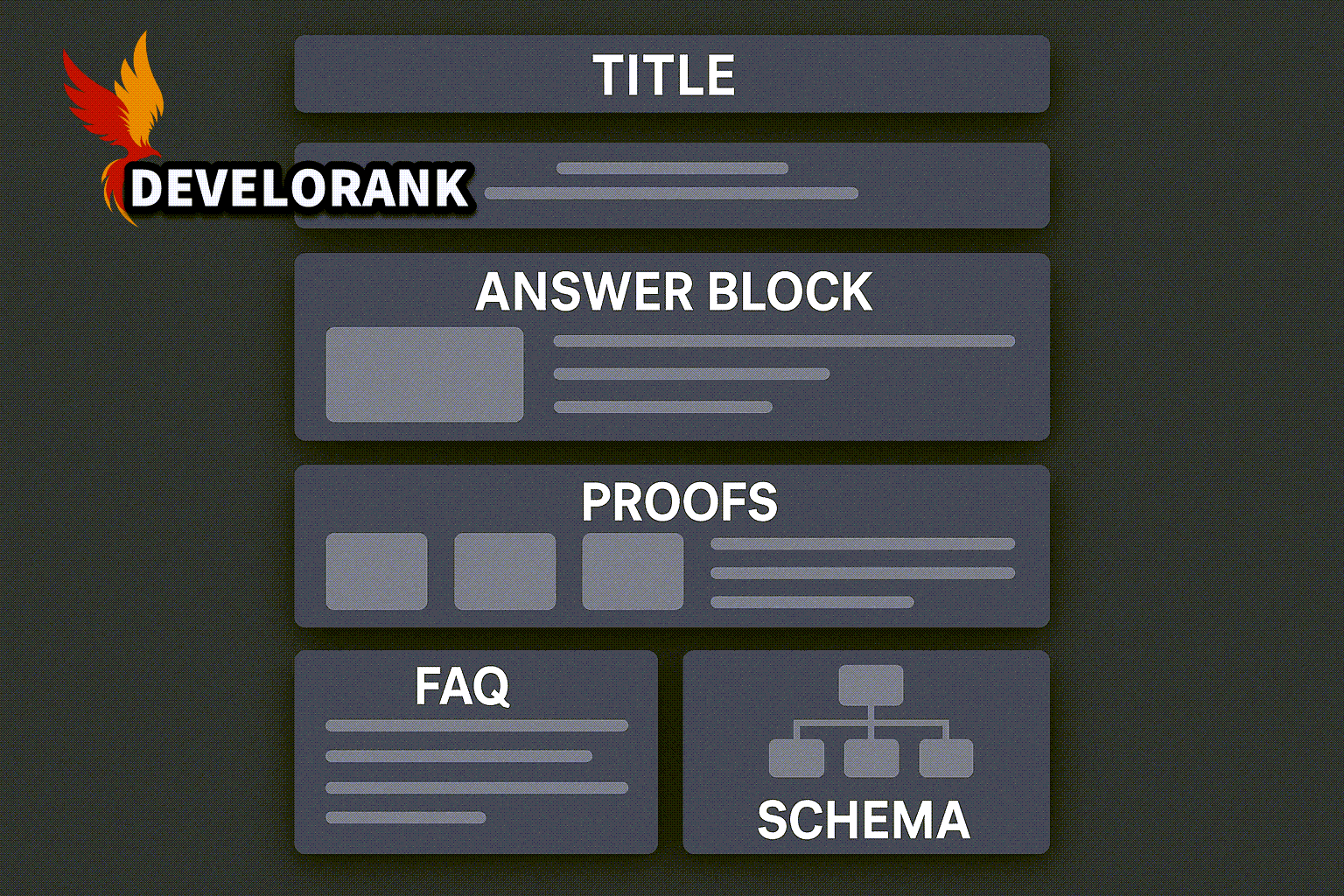
📐 Section Structure
- 🪪 Title: Outcome-focused, entity names spelled out.
- 🧭 Intro: State audience, scope, and key question in 2–3 sentences.
- 🧱 Sections: 150–300 words each, single-intent, labeled with H2/H3.
- 📚 Citations: 1–3 per section (internal + external), with dates.
- 🧪 Summary: One-sentence conclusion per section, quotable on its own.
🧰 Elements to Include
- 🧾 JSON-LD for Article/FAQPage and entities (Organization, Person).
- 📊 One useful data table with clear captions and headers.
- 🧷 Internal links to entity and proof pages.
- 🛰 AI sitemap inclusion for priority assets.
🧪 Advanced Testing: Local RAG, Prompt Harnesses, and Ablation
To master generative engine optimization strategies, test locally. Emulate retrieval and generation so you can iterate quickly before the market reflects changes.
🧰 Minimal Test Bench
- 🧠 Embeddings: Generate vectors for your pages and chunked passages.
- 🔎 Retrieval: Query with your prompt set; log top-k results.
- 🧮 Reranking: Compare cross-encoder reranks vs. plain embeddings.
- 📝 Generation: Run a constrained summarizer; evaluate citations.
🧪 Ablation You Can Trust
- 1️⃣ ✂️ Vary chunk size (100, 200, 300 tokens) and compare retrieval scores.
- 2️⃣ 🏷 Add/remove labels (“Definition,” “Checklist”) and watch citation changes.
- 3️⃣ 📚 Increase citations per section and measure quote precision.
- 4️⃣ 🧱 Reorder content: summary-first vs. detail-first.
For broader standards awareness that underpins web compatibility and machine readability, explore W3C’s standards resources. Alignment with web standards reduces parsing ambiguity across systems.
🌐 From Visibility to Velocity: Turning GEO Into Revenue Motions
Generative engine optimization strategies aren’t just about being mentioned—they’re about moving prospects to the next action. Map your AI answer footprints to conversion nudges that work even when there’s no traditional click.
🧭 Micro-Conversion Design
- 📧 Provide short, copyable outreach scripts in your content to turn summaries into contacts.
- 📄 Offer plain-text checklists and parameters so agents can trigger trials or demos.
- 🔁 Use embedded UTM-ready links where citation contexts allow.
🧠 The strategic shift: optimize for quotability and actionability. If an AI includes your process, your brand becomes the de facto standard—even if a click happens later. Structure your playbooks so they’re easy to reference in two sentences or less, and your generative engine optimization strategies will start influencing pipeline upstream.
🧭 Your Next Steps: A Focused Action Plan
Generative engine optimization strategies pay off when executed with focus. Use this short action plan to turn ideas into momentum this week.
- 1️⃣ 🧾 Choose 10 high-intent topics; draft one-sentence answers for each.
- 2️⃣ 🧱 Create or update entity pages with JSON-LD and sameAs links.
- 3️⃣ 🧭 Add labeled sections and FAQs to two priority articles.
- 4️⃣ 🧪 Build a 25-prompt test set; capture baseline inclusion rates.
- 5️⃣ 🚀 Publish an AI sitemap highlighting your best answers.
⚡ The Strategic Close: From Answers to Authority
Generative engine optimization strategies elevate you from “ranked page” to “trusted voice.” Structure your knowledge so models can find it, trust it, and reuse it. Build entity clarity, pack answers with verifiable proofs, and ship a consistent format that models learn to expect.
“If you want to be quoted by machines, write like a scientist and a teacher—precise, provable, and practical.”
Pick your top themes, publish canonical answers, and measure inclusion every month. The brands that master generative engine optimization strategies in 2025 won’t just get traffic—they’ll set the language the market uses to describe the problem and the path forward.
❓ GEO FAQs: Practical Answers to Common Questions
🤔 What is generative engine optimization in simple terms?
Generative engine optimization strategies tune content so AI systems reliably retrieve, cite, and summarize your pages. It blends technical SEO, structured data, entity design, and answer-first writing. The goal is to become the model’s preferred source for key passages. Unlike classic SEO, GEO focuses on passage-level quotability, verifiable claims, and machine-readable structure that improves inclusion in AI-generated answers.
🧱 How is GEO different from traditional SEO?
Traditional SEO targets rankings and clicks; GEO targets inclusion in AI answers and citations. Generative engine optimization strategies emphasize single-intent sections, schema-backed entities, and compact proofs. Measurement shifts from position tracking to inclusion rates, citation quality, and time-to-correction. You still care about traffic, but you also optimize for influence within AI summaries and agent workflows.
🧭 Which on-page elements matter most for GEO?
Start with outcome-driven titles, labeled sections, and concise definitions. Add JSON-LD for entities, clear citations near claims, and compact lists that fit typical token windows. Generative engine optimization strategies benefit from one-sentence section summaries, updated timestamps, and internal links pointing to canonical answers. Think of each section as a self-contained, quotable unit with evidence attached.
🧪 How do I measure success with GEO?
Use a prompt test set to track answer inclusion, citation accuracy, and narrative framing monthly. Run local RAG tests to score passage retrieval. Generative engine optimization strategies add KPIs like Passage Retrieval Score, Citation Quality Index, and time-to-fix hallucinations. Pair these with classic metrics—engagement, conversions—to capture both AI influence and downstream impact.
🧠 Do I need structured data for GEO to work?
Structured data isn’t mandatory, but it’s a force multiplier. JSON-LD clarifies entities, ties content to public graphs, and stabilizes how models interpret your pages. Generative engine optimization strategies typically see better inclusion and fewer misattributions when Organization, Person, Article/FAQPage, and Product/Service schema are implemented with sameAs links and timestamps.
🧰 What’s a quick win I can ship this week?
Pick two high-intent pages and add a labeled “Definition” box, three citations, and a one-sentence summary per section. Implement JSON-LD and link each to a new entity page. Regenerate your sitemap and create an AI sitemap highlighting them. Generative engine optimization strategies often show inclusion gains within a few weeks after these updates.
🔮 How will GEO evolve over the next year?
Expect more weight on multimodal content, agent-readable instructions, and provenance signals. Generative engine optimization strategies will expand beyond text to charts, audio summaries, and executable steps. Measurement will mature, with standardized inclusion tests and tooling that simulates retrieval, reranking, and generation for your domain in near real time.