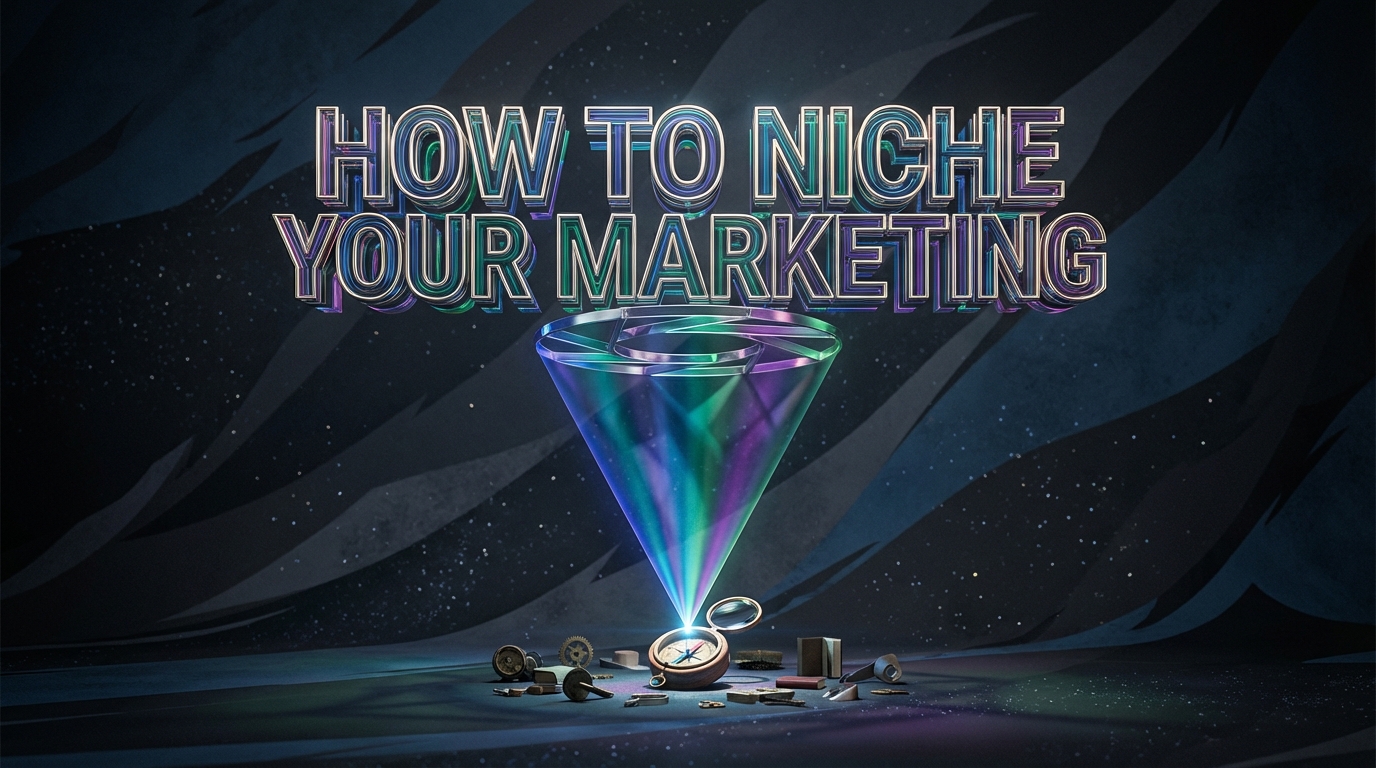
How to niche your marketing: Micro-Segment Strategy Snapshot
Niche marketing in 2026 has evolved from simple demographic targeting to hyper-specific psychographic segmentation powered by predictive AI and first-party data. The industry is currently witnessing a massive shift toward Retail Media Networks (RMNs) and private micro-communities, moving away from broad social media broadcasting. This transition allows brands to bypass the noise of generative AI content saturation.
Key technologies driving this specialization include Robotic Marketer for opportunity gap analysis, generative video tools for personalized commerce, and privacy-first data pipelines. Major players like Amazon, Walmart Connect, and specialized vertical networks are redefining ad spend, while micro-influencers with high engagement rates are replacing celebrity endorsements for authentic peer validation.
Current trends indicate a move toward “Search Everywhere Optimization” where brands optimize for voice, visual, and answer-based queries rather than just keywords. This approach prioritizes depth over breadth, focusing on high-intent micro-segments that deliver superior ROI through community-led growth and trust-based commerce.
🎯 Why Broad Marketing Is Failing Your Business in 2026
Imagine trying to have a conversation with a friend in the middle of a packed stadium while everyone else is screaming. That is what the digital ecosystem looks like right now. The sheer volume of AI-generated content has created a wall of noise that generalist messages cannot penetrate. If you try to speak to everyone, you end up whispering to no one. The era of casting a wide net and hoping to catch a few fish is over; now, you need to be spear fishing with laser precision.
The math simply does not support broad targeting anymore. Customer acquisition costs on general channels have skyrocketed because you are bidding against the entire world for attention. When you niche your marketing, you are essentially walking out of that noisy stadium and into a quiet room with the exact people who need what you sell. You stop competing on price and attention and start competing on relevance and value.
Recent industry analysis confirms this shift is not just theoretical. Data indicates that the digital marketing industry is growing at a 13.9% CAGR, a surge driven almost entirely by the efficiency of niche targeting and AI precision. The businesses winning today are not the ones with the biggest megaphones, but the ones with the most specific frequencies.
📉 The High Cost of Being Average
When your marketing message is designed to appeal to the “average” consumer, it lacks the emotional hook required to trigger a purchase decision in 2026. Consumers are now accustomed to hyper-personalization. They expect brands to understand their specific pain points, not just their general category of interest. If you sell “fitness gear,” you are invisible. If you sell “high-impact knee support for trail runners over 40,” you are a savior.
This lack of specificity leads to wasted ad spend. You pay for impressions from people who were never going to buy, dragging down your conversion rates. By narrowing your focus, every dollar spent works harder because it is directed solely at high-probability prospects. It is the difference between watering a garden with a firehose versus a drip irrigation system; one makes a mess, the other creates growth.
🤖 How Can AI Identify Underserved Micro-Segments?
You no longer have to guess where your niche lies. The most powerful application of artificial intelligence in marketing isn’t writing copy; it is finding the holes in the market that your competitors have missed. Predictive modeling tools can now analyze vast oceans of data to spot patterns in customer dissatisfaction or unmet needs. These are your “blue ocean” opportunities—micro-segments where demand exists but supply is lazy or nonexistent.
Think of AI as a metal detector for market gaps. It scans through forums, reviews, search behaviors, and competitor weaknesses to ping you when it finds gold. For instance, platforms like Robotic Marketer use predictive analytics to identify these underserved micro-segments. In documented cases, this approach has led to a massive 240% increase in qualified leads. This isn’t magic; it is math applied to human behavior.
- 🤖 Pattern Recognition: AI spots recurring complaints in competitor reviews that signal a specific gap.
- 📊 Behavioral Clustering: Tools group users not by age or location, but by the specific problem they are trying to solve.
- 🔮 Predictive ROI: Models calculate the potential profitability of a niche before you spend a dime entering it.
- ⚡ Speed to Market: Automated analysis allows you to launch a campaign for a new micro-segment in days, not months.
Once you identify these gaps, you can deploy lean, hyper-focused strategies. Instead of building a massive campaign, you build a sniper campaign. You create content that speaks the specific dialect of that micro-segment. If the data shows a group of accountants who love heavy metal music are underserved, you don’t market “accounting software”; you market “rebellious financial tools for the loud professional.”
🛒 Why Are Retail Media Networks (RMNs) the New Niche Powerhouse?
The cookie is dead, but the shopping cart is very much alive. Retail Media Networks (RMNs) have emerged as the dominant force for niche targeting because they possess the one thing social media platforms lost: actual transaction data. When you advertise on a retailer’s network, you aren’t guessing if someone likes coffee based on their likes; you know they bought a French Press last Tuesday. This allows for full-funnel targeting tied directly to SKU-level outcomes.
This precision is why RMNs are projected to exceed 20% of all digital media spend in 2026. It is the ultimate niche environment. You can target consumers who buy your competitor’s brand, or consumers who buy complementary products. If you sell gourmet pasta sauce, you can place your ad specifically in front of people buying high-end gluten-free pasta. That is a level of contextual relevance that a billboard or a Facebook feed simply cannot match.
| Feature 🛠️ | Traditional Digital Ads 📺 | Retail Media Networks 🛒 |
|---|---|---|
| Targeting Source | Interests & Demographics | Real Purchase History |
| Intent Level | Passive Browsing | Active Shopping Mode |
| Performance | Standard Conversion Rates | 1.8x Better Results |
| Purchase Intent | Varies Widely | Nearly 3x Higher |
The effectiveness of this channel is undeniable. According to recent data from Kantar, RMNs deliver 1.8x better results than standard digital ads and nearly 3x better metrics for purchase intent. For a niche marketer, this is the holy grail. You are paying to reach people who have their wallets out and are standing in the aisle (digital or physical) where your product lives.
Furthermore, worldwide retail media advertising is projected to capture an accelerated share of ad spend, reaching huge valuations like $169 billion. This isn’t a trend; it’s a structural change in how products are discovered. If you aren’t integrating RMNs into your niche strategy, you are essentially setting up a stall outside the mall instead of renting a shelf inside the store.
🤝 How Do Micro-Communities Drive Higher ROI?
While RMNs capture the transaction, micro-communities capture the heart. The era of the “town square” social media is fading, replaced by the “private lounge.” People are tired of broadcasting their lives to strangers; they want to share knowledge and passions with peers who get it. These are Discord servers, Slack groups, specialized subreddits, and private membership circles. For a niche marketer, these are concentrated pools of high-trust prospects.
Marketing here requires a different touch. You cannot just blast ads. You have to participate. You have to contribute value before you extract value. But when you do it right, the returns are astronomical. Brands that effectively utilize knowledge-sharing micro-community platforms are seeing 25% higher marketing ROI. Why? Because a recommendation in a closed group of enthusiasts carries the same weight as a personal referral.
To succeed here, you need to monitor the narrative. You need to understand the inside jokes, the specific jargon, and the shared values of the group. It is about becoming a member of the tribe rather than a vendor knocking on the door. Once you have that trust, you don’t need to sell hard. The community does the selling for you.
📹 What Role Does Gen AI Video Play in Niche Commerce?
Video has always been the king of engagement, but production costs used to keep niche brands from competing with giants. You couldn’t afford to shoot a high-quality commercial for a product that only appeals to 5,000 people. Generative AI has smashed that barrier. Now, you can produce studio-quality video assets tailored to hyper-specific niches at a fraction of the cost and time.
This capability is transforming advertising. Data shows that 86% of advertisers are using or planning to use generative AI for video ad production. By 2026, AI-created video ads are projected to represent roughly 40% of all video ads. This means you can create 50 different versions of a video ad, each tweaking the script, the visual style, and the call-to-action to match 50 different micro-segments.
Imagine you sell ergonomic office chairs. With Gen AI, you can generate one video targeting gamers (emphasizing style and recline), another for coders (emphasizing focus and posture), and another for writers (emphasizing comfort for long hours). Same product, different story, zero reshoots. This is hyper-niche video commerce.
- 🎥 Scale Without Cost: Produce hundreds of variations without hiring a production crew.
- 🎯 Visual Relevance: Change the background and actor avatar to match the demographic of the viewer.
- ⚡ Real-Time Iteration: If a specific angle isn’t working, generate a new version in minutes based on performance data.
- 🛍️ Shoppable Integration: Embed direct purchase links into videos that are contextually perfect for the viewer.
🗣️ Why Are Micro-Influencers Beating Celebrities?
Trust is a finite resource, and celebrities have overspent theirs. We all know the A-list actor doesn’t actually drive that affordable sedan. But the micro-influencer—the woodworker with 15,000 followers who reviews saw blades—has immense credibility. Their audience knows them, trusts their expertise, and listens when they speak. In the niche game, authenticity beats reach every single time.
The numbers back this up heavily. Micro-influencers are achieving an average 1.81% engagement rate, which significantly outperforms larger creators. They aren’t just broadcasting; they are having a conversation. Their followers are there for the specific topic, not just for entertainment.
Agencies have caught on to this shift. A staggering 75% of agencies believe that micro and niche influencers will drive more impact than celebrity endorsements in 2026. For you, this means your budget goes further. Instead of spending $50,000 on one post that gets ignored by millions, you spend $5,000 on ten partners who get deep engagement from thousands of potential buyers.
🔎 What Is “Search Everywhere Optimization”?
People don’t just type keywords into a search bar anymore. They ask voice assistants, they snap photos with visual search, and they converse with AI chatbots. “Search Everywhere Optimization” is the strategy of ensuring your niche brand appears across all these varied discovery points. It is about being the definitive answer, no matter how the question is asked.
To dominate a niche, you must move beyond simple keywords and focus on “answer-centered” content. When a user asks an AI, “What is the best vegan leather boot for wide feet?”, the AI pulls from sources that provide specific, authoritative details. If your content is generic, you get ignored. If your content specifically addresses “vegan leather,” “wide feet,” and “durability,” you get cited.
This requires a shift in content strategy. You need to structure your data and content so machines can easily understand it. Schema markup, clear headings, and direct answers to specific questions are critical. You are optimizing for the machine that feeds the human. Niche brands are building resilience by anticipating this shift, preparing for a world where 40% of video ads and search results are driven by generative AI logic.
📊 How to Prioritize Channels with Lean Dashboards
One of the biggest traps in niche marketing is trying to be everywhere at once. You cannot dominate a niche if your resources are spread thin across ten different platforms. The secret to execution is lean prioritization. You need to identify the one or two channels where your specific audience is most active and go all-in on them.
This is where data visualization saves your sanity. Using AI-driven dashboards, you can monitor real-time metrics to see exactly where your leads are coming from. You don’t need a massive team; you need a smart dashboard. Tools that offer digital dashboards allow you to sequence your campaigns based on data, not gut feeling. You reserve your human creativity for high-insight tweaks while automation handles the daily grind.
For example, if your dashboard shows that your “urban gardening” niche converts 4x higher on Pinterest than on TikTok, you ruthlessly cut TikTok and double down on Pinterest. You prioritize one high-value niche channel at a time for scalable dominance. Once you have conquered one hill, then—and only then—do you move to the next.
🔒 How to Build First-Party Data Pipelines
You cannot rent your audience forever. The platforms change, algorithms shift, and ad costs rise. The ultimate insurance policy for niche marketing is owning your data. First-party data pipelines are systems you build to collect information directly from your customers, bypassing the tech giants entirely. This is your most valuable asset.
How do you get this data? You exchange value for it. Quizzes, loyalty programs, and exclusive content are the tools of the trade. A quiz titled “Find Your Perfect Skincare Routine” isn’t just a fun engagement tool; it is a data collection engine that tells you exactly what skin type, budget, and concerns a user has. This allows for precise segmentation that no third-party cookie could ever match.
Agencies are prioritizing these first-party data pipelines to counter privacy shifts. When you own the data, you can upload it to RMNs or email platforms to create lookalike audiences that are startlingly accurate. It counters the “walled garden” problem by giving you a portable audience that you can take anywhere.
🔮 Future-Proofing Your Niche Strategy
The landscape of 2026 is defined by a return to authenticity amidst a sea of synthetic content. As AI becomes better at faking humanity, real humanity becomes a premium product. Your niche strategy must be built on a foundation of transparency and genuine connection. The brands that will survive the next five years are the ones that use AI to handle the logistics but use humans to handle the relationships.
Privacy will continue to tighten. Trust will continue to fragment. The only safe harbor is a deep, direct relationship with a specific group of people who believe what you believe. Niche marketing is not just a tactic; it is a philosophy of respect. It respects the customer’s intelligence, their time, and their specific needs. It says, “I see you,” rather than “I see a wallet.”
By leveraging the tools of 2026—predictive AI, RMNs, micro-influencers, and first-party data—you can build a moat around your business that no generalist competitor can cross. You don’t need to win the whole world. You just need to win your corner of it.
Common Questions About How to niche your marketing
What is the first step to niche down?
Start with audience analysis using AI tools to identify specific pain points and underserved micro-segments within your broader market. Look for gaps where competitors are failing to address specific needs.
Are micro-influencers better than big creators?
Yes, for niche marketing. Micro-influencers typically see higher engagement rates (around 1.81%) and possess greater trust within specific communities, offering better ROI than expensive celebrity endorsements.
How do Retail Media Networks help niches?
RMNs provide access to actual purchase data, allowing you to target consumers based on buying behavior rather than just interests. This delivers nearly 3x better purchase intent for niche products.
Is general marketing dead in 2026?
Broad, undefined marketing is largely ineffective due to high costs and AI content saturation. Success now relies on precision targeting and relevance to specific micro-communities.
How does AI help with niche content?
Generative AI allows you to produce high volumes of tailored content, such as personalized video ads, at scale. This lets you create unique messaging for dozens of different micro-segments affordably.